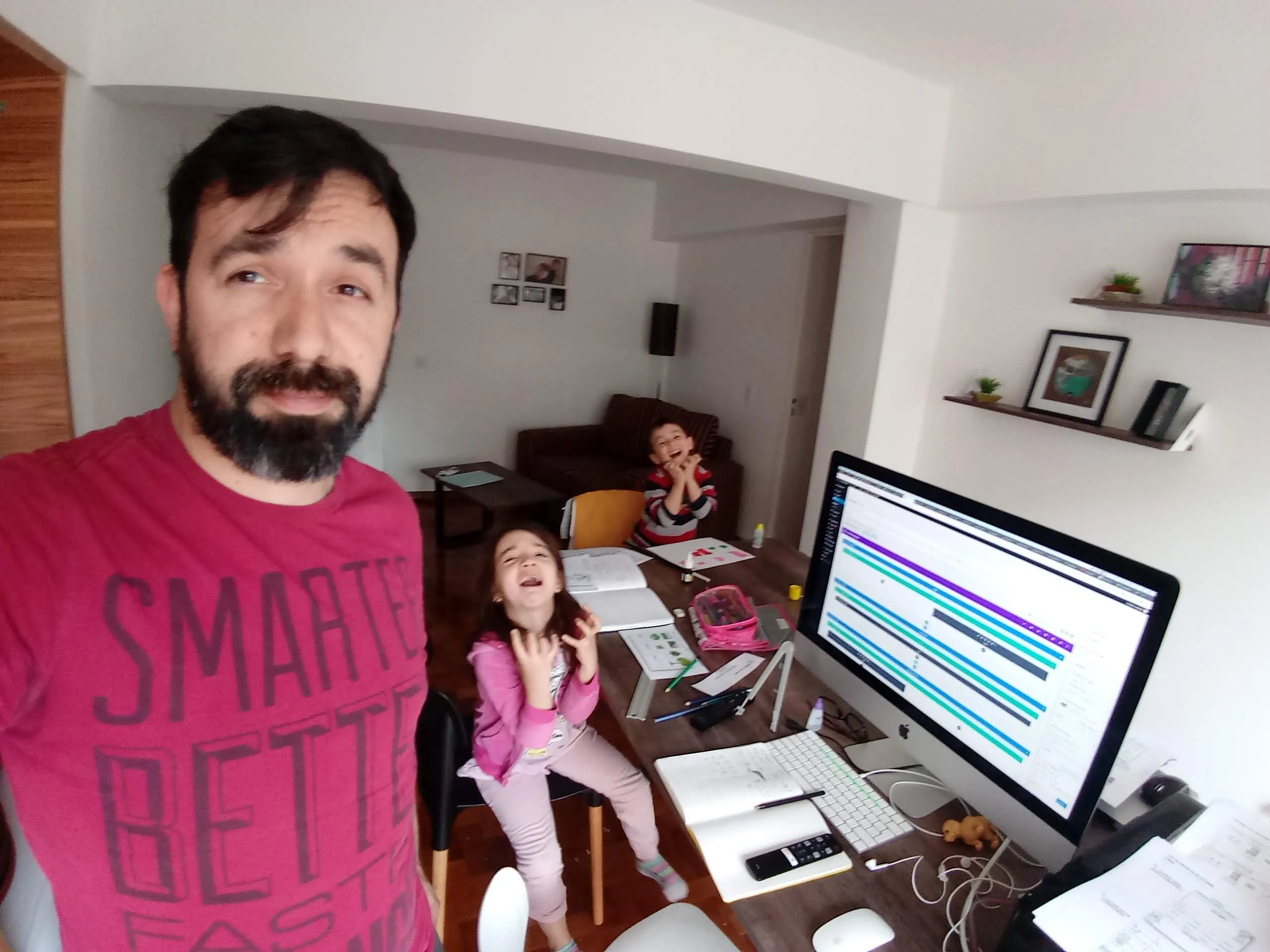
6 a.m. The alarm goes off. A couple of scrambled eggs, a coffee, and it’s time to work with 100% focus. At noon I put the computer to sleep, go pick up my kids from school and we have lunch together at home. After lunch, I alternate video calls and urgent emails with school assignments and drives to the kids’ activities: English, taekwondo, swimming, theater. There’s always something. At 6:30 p.m. I block out time for myself: the gym or my Tuesday soccer game with friends. At 8 p.m., I turn the computer back on and finish whatever’s still pending before calling it a day. That routine, which many people would find unthinkable, is what allows me to work without disappearing from my kids’ lives.
It wasn’t always like this. For years I worked office hours and commuted. The day had a structure in which I did what I could, not what I wanted. The pandemic didn’t invent working from home, but it made it a real possibility for a lot of people. In my case, it changed my life.
What the pandemic forced us to try
It was March 2020, and every day we arrived at the Kaleida office with increasingly worrying news about a COVID that kept getting closer. Until one day the decision was made long before the government decided for everyone else: “guys, we’re going to work from home, just in case.” Shortly after, the whole world ran a forced experiment: millions of people worked from home for months. Many companies discovered that productivity didn’t collapse, that meetings could be shorter and that talent didn’t have to be in the same city. When the lockdown ended, many companies also discovered that they missed the office, that isolation weighed on them and that not everyone had a proper space to work from home.
The discussion was framed as “remote vs. in-person,” as if they were two religions. I think it’s a false dichotomy. The question isn’t where you work, but how work is organized. A well-run home office is much more than “working from home”; it’s a management model based on goals, mutual trust and clear communication. And watch out: badly run, it’s an office that never closes.
My case
I’m divorced and have two young kids. Family logistics are a puzzle that changes every week: school schedules, after-school activities, birthdays, last-minute surprises. If I had to keep strict office hours, I’d see very little of my kids. The logistics would be extremely complex to coordinate with their mom and would almost certainly end up sacrificing personal time: exercise, reading, the things that don’t show up on any calendar but hold everything else together.
Working from home gave me the ability to organize the day around what matters. I can start early, take a break to pick them up, and reconnect later. It’s not a perfect schedule: some days run long, some weeks are more intense, and some video calls collide with math homework. But balance is possible. And for a father who wants to be present, that isn’t a small benefit: it’s the necessary condition.
It also gave me something I value more and more: quality time with myself. I use the time I used to lose commuting to exercise, cook, read ten pages before bed. It isn’t productivity: it’s health. A job that leaves you with no energy for your own life isn’t a good job, no matter how nice the office is.
What companies gain
Working from home isn’t just a benefit for the employee. Done well, it also improves the company’s side of the equation:
- Less physical space. Lower rent, fewer utilities, less maintenance.
- Access to talent from anywhere. You can hire the best person, not the closest one.
- Flexibility to scale. Grow or shrink the team based on projects, without moving offices or leaving desks empty.
- Less commuting. More time and energy for the actual work.
- Retention. People value flexibility and stay longer.
None of this is automatic: it takes a lot of trust. If a company measures presence instead of results, working from home turns into uncomfortable surveillance. If employees abuse that freedom and flexibility, the goals don’t get met either.
What I don’t like
I don’t want to paint a rosy picture. Working from home has costs:
- Isolation. Sometimes I miss the informal conversations, the ones that aren’t on any meeting invite and sometimes unblock a problem.
- Blurred boundaries. The computer is always there. It’s easy to answer a message at eleven at night or check email on a Sunday.
- Unequal conditions. Not everyone has a spare room, a good connection and silence. Working from home can be a privilege disguised as a norm.
- Coordination. Without clear processes, remote work turns into a string of messages and meetings that could have been an email.
- Junior team members. Learning from a colleague at a distance is hard, and almost impossible without explicit mentorship.
That’s why I don’t think working from home is for everyone or for every stage of life. I think it’s a tool. And like any tool, it depends on how you use it.
How we do it at Kaleida
I’ve worked at Kaleida for almost twenty years. The relationship has survived every working model because it was never based on clocking in and out, but on solving problems and trusting that the other person is doing their job.
To me, that’s the key. Working from home works when there’s trust but also when there are results. If there’s no trust, no office is going to fix it. If there are no results, no amount of hours at a desk will invent them, wherever you are.
And something very important: every now and then we get together, not necessarily to work. We grab a coffee or have lunch together. We catch up on personal stuff. In the end, we’re nurturing the relationship, something every team needs.
Balance isn’t a perk
The debate shouldn’t be “back to the office” or “stay home.” It should be what each team needs to do its best work. For me, today, the answer is a home office with clear boundaries, measurable goals and the ability to be present in my kids’ lives. It isn’t a privilege I’m asking for: it’s the structure that lets me work better.
And if that structure stops working someday, we’ll talk about it. In the meantime, at three in the afternoon on a Tuesday, I can’t take a call: I’m driving Oli to English class.