For years, the end of the month at Cross MKT came with a ritual I hated. I’d log into Google Ads, Meta Ads and each client’s social accounts, export data, paste it into spreadsheets, build charts, write comments, turn it all into a PDF and send it by email. The result was a report several pages long that most clients opened once, if that.
Every new client added hours of collecting and formatting. The process didn’t scale: to grow, I had to hire someone, raise my fees or work more hours. None of those three options appealed to me.
The decision
So I started building a tool that went after the root cause.
I began with an internal version: ugly and functional. It connected the accounts, consolidated the data and generated a report. It wasn’t meant to be a product. I just wanted my Saturdays back. The first version had no design, no onboarding, no name. It had one obsession: making the end of the month stop being a weekend of work.
The result
The tool worked. What used to take days started taking hours. Then minutes. I used the time I freed up to do the work that matters better: analysis, strategy, content, client relationships. And into having more free time, too.
But the best part was the impact on the business: my profitability went up by more than 20% without charging my clients a dollar more. The same fee started covering fewer hours of repetitive work. That’s the part almost no one talks about with automation: it doesn’t just save time, it changes the economics of the business.
From internal tool to product
For a while, Clarika was just mine. Then a colleague saw it and liked it. I mentioned it to another one and he was in the same boat. That’s when I understood the problem wasn’t only mine: a lot of independent professionals and small agencies go through the same end-of-month ritual.
Turning it into a SaaS was a project in itself. There was white-labeling, permissions, onboarding, security, billing, support. It was no longer a tool for me; it was a product for other agencies. Every decision had to work for someone who didn’t know my context.
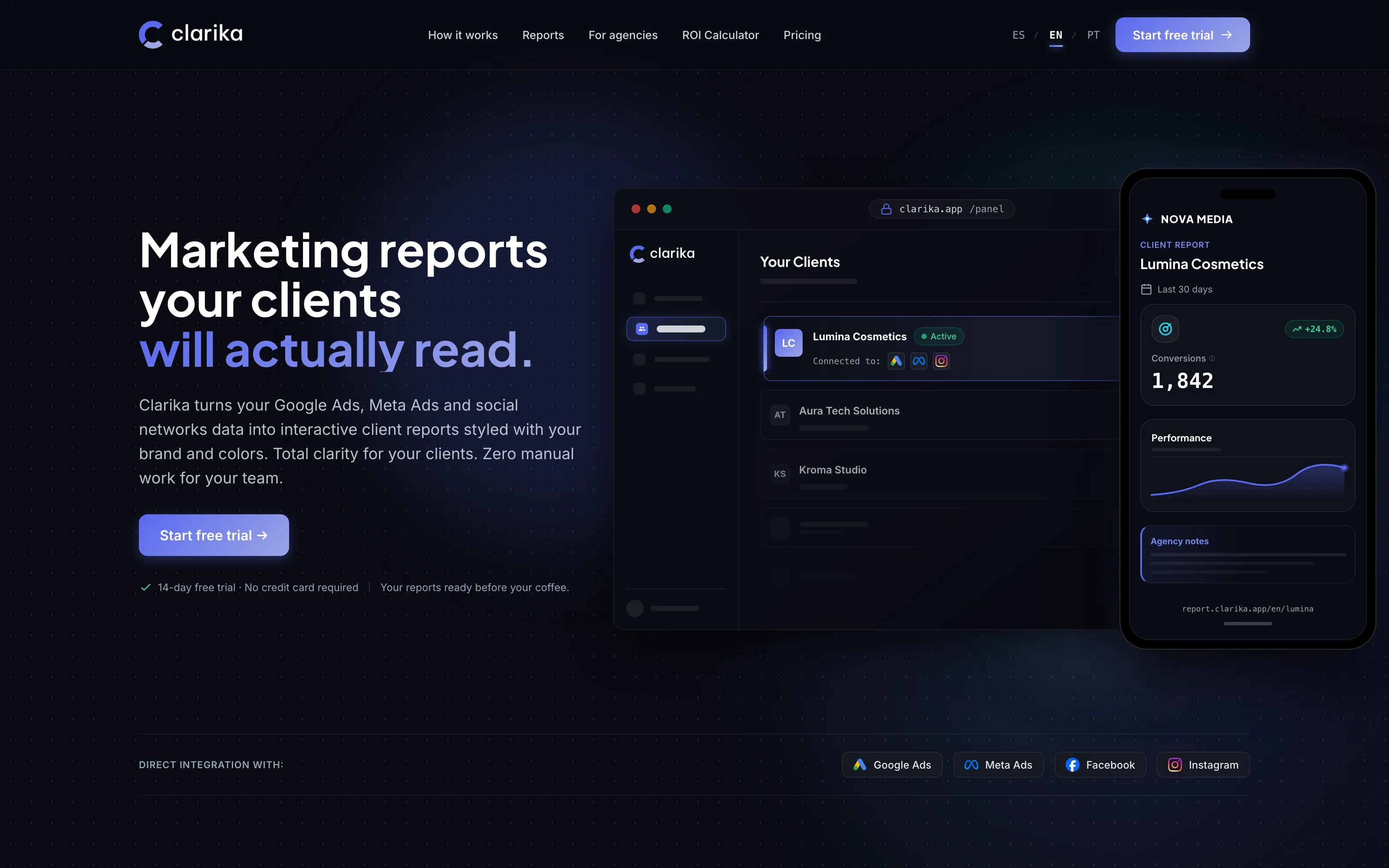
Today, Clarika lets each agency put its own brand and colors on its reports, connect client accounts, add their clients’ data and generate reports in minutes. A task that used to take several days now takes a couple of minutes. And their clients can log in whenever they want to see their metrics, without waiting for the end-of-month PDF.
What I learned
- Build for a real pain. Not for a pretty idea. The best validation was that I needed it myself every month.
- Measure the time. If you don’t know how many hours a process takes, you can’t defend the investment in automating it.
- Automate the repetitive, not the judgment. The tool doesn’t decide strategy. It organizes the data so you can make better decisions.
- Productize when demand repeats. Not when the idea is cool. If other people have the same problem, that’s a signal.
- The product is also a design project. The interface, the onboarding, the copy, the brand. Everything communicates.
What’s next
Clarika is still in its early days. Every week brings new requests: more integrations, more formats, more automations. The temptation is to say yes to everything. The discipline is saying no to what doesn’t solve the core problem. A tool that tries to do everything ends up doing nothing well.
My goal is still the same as when I built it for myself: for the end of the month to stop being a burden, and for the time it frees up to go toward what actually moves the business. If that happens for me and for other agencies, Clarika makes sense.
Clarika wasn’t born to be a SaaS. It was born so I could close the month without losing a week. Then I realized the problem wasn’t only mine. And that’s probably the best way to build a product: start with a need of your own, solve it well, and only then ask whether it helps anyone else.